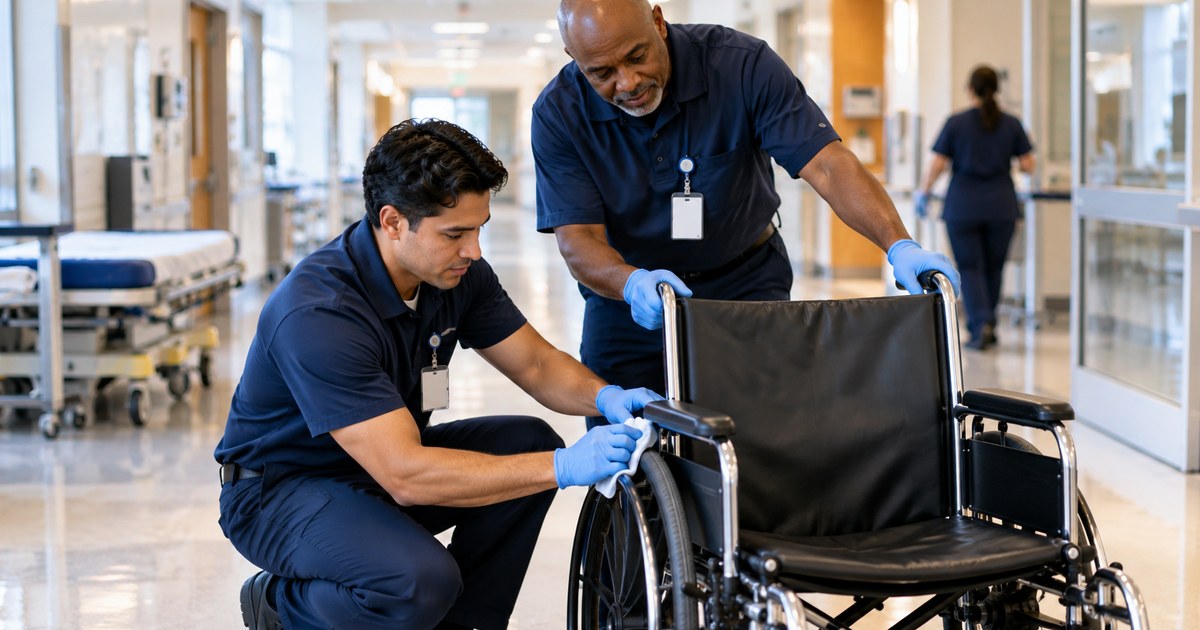
Patient transport is often a new hire's first entry into healthcare. The job looks simple from a distance: receive a request, move a patient, close the trip. In practice, each move involves communication, patient dignity, equipment checks, handoffs, and timing. A training pathway should make those expectations visible before a transporter works alone.
For hospitals across the United States, the most useful question is not “Which course should everyone take?” It is “What should this person be able to do at each stage of the role?” Start with the work in your own facility, then choose education and credentials that support it.
Start with a local task map
Walk the routes your transporters actually cover: emergency department to inpatient unit, unit to imaging, procedural area to recovery, and discharge to the exit. Note the equipment used, the receiving team's expectations, and where delays or unclear ownership occur. A community hospital and a large academic center may use the same core skills while needing different routes, escalation steps, and dispatch rules.
Turn that map into a short list of observable competencies. A new hire should be able to verify the request and patient identity according to facility policy, communicate with the sending and receiving teams, prepare the appropriate transport equipment, protect privacy, and recognize when to stop and ask for clinical help.
Build the pathway in stages
- Orientation: Explain the transporter's role in patient experience, safety, and hospital flow. Show how requests are assigned and documented.
- Foundational learning: Teach the shared language of transport, professionalism, communication, and equipment readiness. Self-paced learning can give every new hire the same starting point.
- Supervised practice: Pair the learner with a qualified colleague on real routes. Observe handoffs, patient interactions, and response to changing priorities.
- Competency check: Use direct observation and clear criteria. A completed course alone does not prove that a person can perform each task in your facility.
- Ongoing development: Revisit skills after onboarding, especially when equipment, routes, or dispatch processes change.
A practical distinction: An entry-level certificate can establish a common knowledge base. A professional credential can mark a deeper standard. Your hospital still needs to validate local, hands-on competency.
Choose training that matches the stage
Impact Training Online offers self-paced healthcare support services education, including the Healthcare Patient Transporter (HPT) foundation. It can help individuals and hospital teams build consistent baseline knowledge around shifts. For organizations ready to establish a broader professional pathway, Impact Training Company's Certified Healthcare Transporter (CHT) credential is delivered through an instructor-led model inside the hospital, with competency validated on the job. The two options serve different stages; they should be described accurately to learners.
Ask your transport leaders to review one month of onboarding records and three common trip types. If staff can explain the policy but practice varies by shift, add observation and coaching where the work happens. That is where a pathway becomes a reliable standard.